
Walking through the landscape instead of looking at it
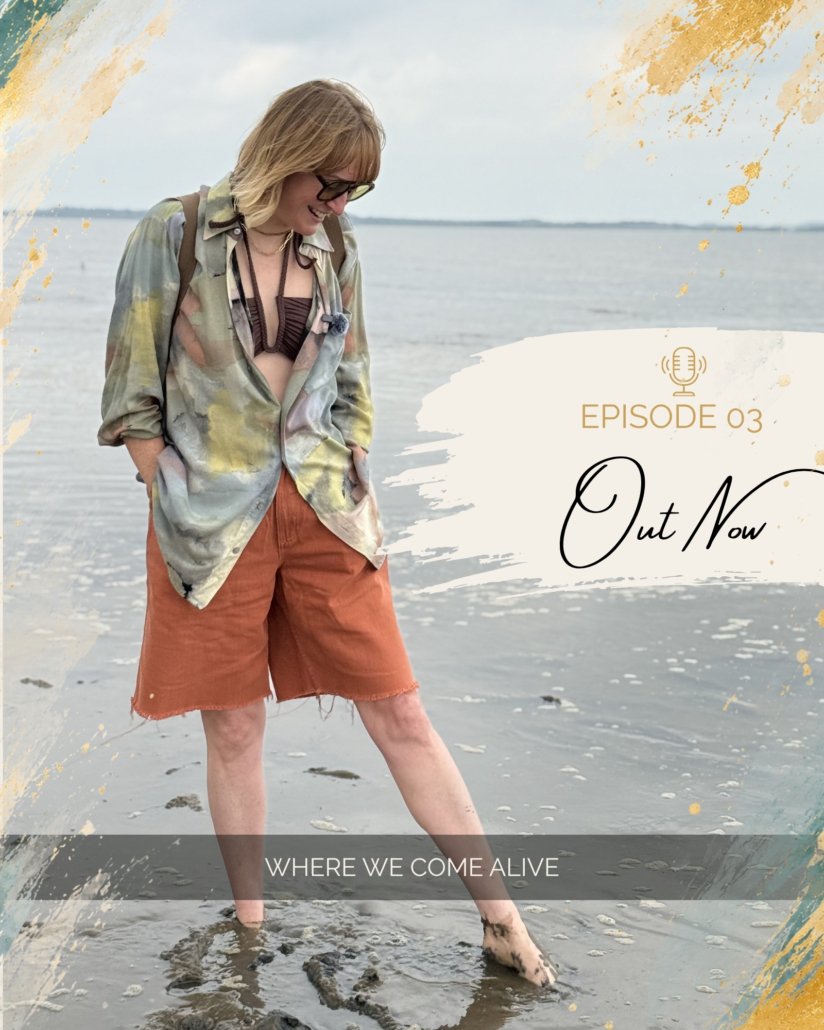
Walking Through the Sea with Kim O’Neil:
What Happens When We Stop Trying to Control Nature?
There are some podcast recordings where the landscape provides a backdrop.
And then there are recordings where the landscape becomes part of the conversation.
My recent episode of Where We Come Alive with environmental artist Kim O’Neil was definitely the latter.
By the end of our walk, we’d waded through shallow water, got stuck in the mud, watched crabs scurry across the sand, spotted jellyfish drifting on the tide and listened to seagulls calling overhead.
It felt less like an interview and more like an adventure.
And perhaps that was fitting, because Kim’s work is built around exactly that idea: stepping into the landscape rather than observing it from a distance.
1. Walking Through the Landscape Instead of Looking At It
We met at Seasalter, a stretch of Kent coastline that has become deeply significant in Kim’s life and artistic journey.
As we walked through the shallows, Kim described the beach as the “epicentre” of change within her creative practice.
What struck me almost immediately was the way she experiences a place.
Many artists are described as visual people.
Kim describes herself differently.
“I’m more tactile,” she told me.
For her, creativity begins through touch.
While most of us might admire a rock, a shell or a piece of driftwood from a distance, Kim wants to feel it. She wants to understand its texture, its surface and the emotions it evokes.
Standing on the shoreline, she picked up a worn fragment of terracotta, weathered by years in the sea.
What fascinated her wasn’t simply how it looked.
It was what it had become.
A human-made object transformed by wind, salt, water and time.
That idea feels central to her work.
Not imposing something onto nature.
But allowing nature to leave its mark.
2. Trusting the Landscape More Than Your Plans
One of the most powerful moments in our conversation came when Kim described her creative process.
Unlike many artists, she rarely begins with a fixed idea of what the finished work will look like.
Instead, she arrives with openness.
No blueprint.
No certainty.
No need to control the outcome.
As she put it:
“I trust nature more than I trust myself.”
It’s a remarkable statement.
Especially in a world that constantly encourages us to plan, optimise and control every aspect of our lives.
Kim takes canvases into the sea.
She allows tides, weather, mud, saltwater and wind to alter the surface.
The landscape becomes a collaborator.
Sometimes she makes a mark.
Sometimes nature makes one.
And often the most interesting work emerges from the conversation between the two.
Listening to her speak, I couldn’t help thinking how applicable this feels beyond art.
How much energy do we spend trying to control things that were never ours to control in the first place?
3. The Sea as a Co-Creator
One of the recurring themes throughout the episode was collaboration.
Not collaboration with another artist.
Collaboration with the natural world itself.
Kim described how the environment influences every stage of her work.
The tide.
The weather.
The season.
The atmosphere.
The unexpected.
Rather than seeing these as obstacles, she actively welcomes them.
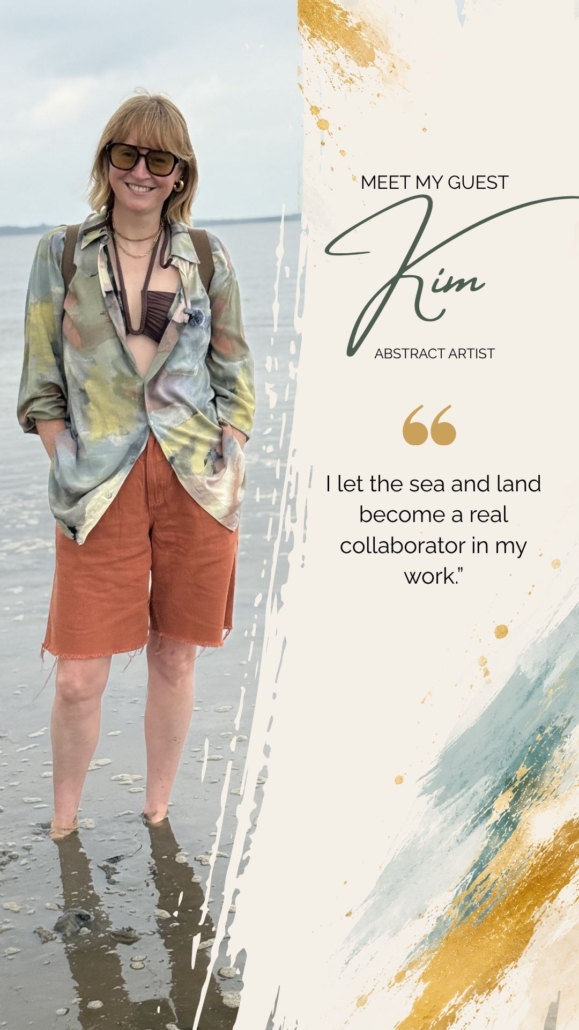
“The environment becomes this co-collaborator.”
I loved that phrase.
Because it captures something I think many of us have forgotten.
Nature isn’t separate from us.
We’re part of it.
Kim spoke beautifully about how modern life often creates the illusion that we’re somehow outside nature looking in.
Yet we remain deeply connected to it.
Our bodies.
Our emotions.
Our responses.
Even our creativity.
The more she spoke, the more I realised this wasn’t really a conversation about painting at all.
It was a conversation about relationship.
4. What Imperfection Can Teach Us
Kim is fascinated by weathering, erosion and organic surfaces.
The things many people might dismiss as rough, messy or imperfect.
And yet she sees enormous beauty within them.
At one point I asked what those textures teach us.
Her answer stayed with me.
She spoke about the pressure so many of us feel to be perfect.
To look perfect.
To perform perfectly.
To have our lives neatly arranged and controlled.
But nature doesn’t work like that.
Nature is chaotic.
Layered.
Unpredictable.
Constantly changing.
“There is no such thing as perfection,” she said.
And standing there surrounded by shifting mudflats, seaweed and tide lines, it felt impossible to disagree.
Nothing around us was perfect.
And everything was beautiful.
Perhaps that’s why so many of us feel calmer outdoors.
Nature quietly gives us permission to stop striving.
To soften.
To be human.
5. Becoming Part of Something Bigger
Towards the end of our walk, Kim reflected on how motherhood had transformed her relationship with creativity.
She described it as a rewiring.
A shift in perspective.
A moment when she realised she no longer wanted to remain inside a controlled studio environment.
Instead, she wanted to work within what she called “the biggest studio.”
The landscape itself.
That phrase felt like a beautiful summary of the entire episode.
Because what Kim ultimately offers isn’t simply a different way of making art.
She offers a different way of being.
A reminder that we don’t have to stand apart from the world.
We can step into it.
We can allow ourselves to be shaped by it.
We can stop trying to dominate every outcome.
We can trust.
As we finished recording, my feet were covered in intricate patterns of mud. We’d dodged jellyfish, laughed about getting stuck in the shallows and spent nearly twenty minutes immersed in the elements.
And that word feels important.
Immersed.
Not observing.
Participating.
Because perhaps that’s what Where We Come Alive keeps returning to again and again.
Whether it’s flowers, gardens, meditation, painting or the sea, the invitation is always the same.
To step outside.
To pay attention.
To become part of the landscape rather than merely looking at it.
And perhaps, in doing so, discover a little more about ourselves.
Listen to the episode
If you’ve ever felt overwhelmed by the pace of modern life, this episode is an invitation to slow down and see the world differently. Walking through the sea with artist Kim O’Neil, you’ll be immersed in the sights, sounds and textures of the shoreline while exploring creativity, connection and our relationship with the natural world.
It’s a conversation that gently reminds us that we don’t always need to control everything; sometimes the most meaningful experiences happen when we pay attention, embrace uncertainty and allow ourselves to become part of the landscape around us.
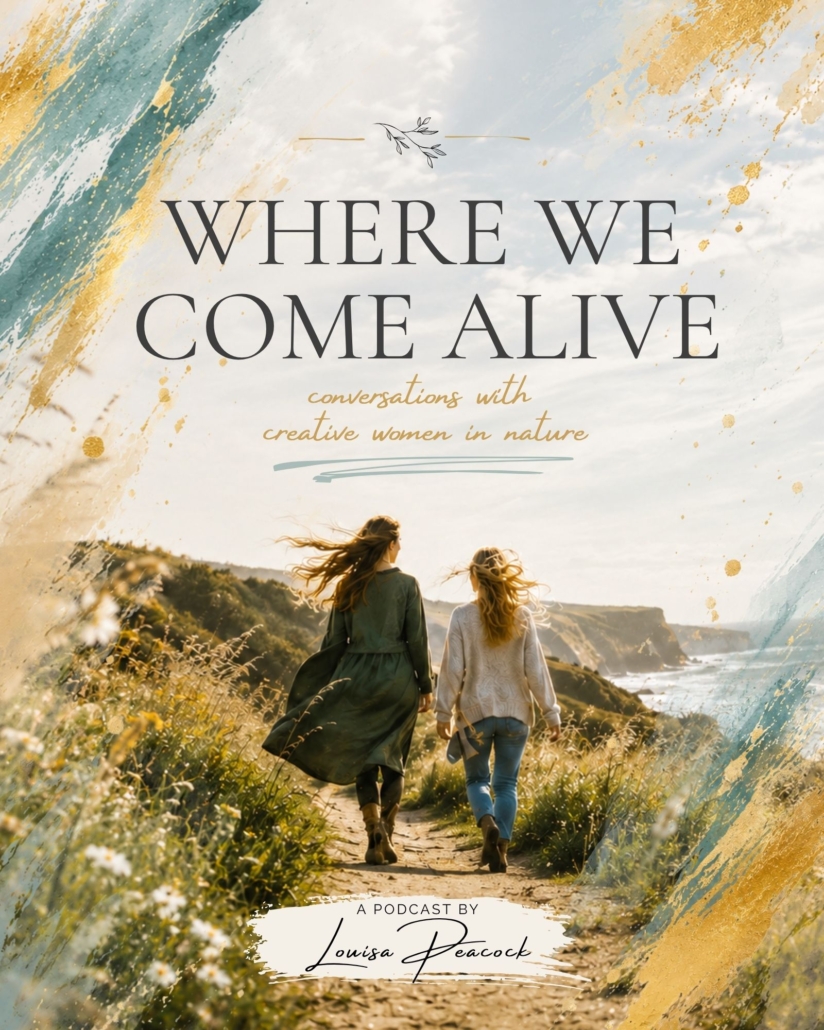
If you enjoyed this conversation, you’ll find more episodes of Where We Come Alive waiting for you on Spotify, Apple, Amazon or wherever you get your podcasts. Each week, I spend time outdoors with a different woman in a place she loves, exploring how nature, creativity and landscape shape the way we live, see and feel.
Louisa Peacock creates fine art photographic prints that celebrate the beauty, stillness and wonder of the natural world. Inspired by the changing seasons, wild landscapes and the quiet moments often overlooked, her work is an invitation to slow down, notice more deeply and reconnect with the places that make us feel most alive. Each piece is thoughtfully produced as timeless artwork for homes that value beauty, nature and meaningful living.
The Where We Come Alive podcast is on all major platforms including Apple, Amazon and Spotify. Please follow me wherever you get your podcasts to ensure you don\’t miss an episode.

