
How I create a fine art photograph, from idea to finished print
There is something quietly strange about showing the work that happens behind the curtain.
People often see the finished photograph first. The stillness. The atmosphere. The softness. The finished piece, printed and ready to live on a wall.
What they do not always see is everything that came before it.
The half-formed idea scribbled down before it made sense. The early questions. The location visits. The checking of tide times, weather, light, clothing, movement, and whether the sea is going to behave itself. The moments that do not work. The things I remove. The decisions I make quietly, often by instinct, until the image begins to feel like itself.
For me, creating a fine art photograph is not simply about taking a beautiful picture.
It is about intention.
It is about listening to the idea long enough to understand what it is asking for. It is about choosing what belongs in the frame, and what needs to be left out. It is about making something that feels honest, even if it also feels dreamlike.
So, this is a little look behind the curtain. Not a technical step-by-step guide, because that is never quite how it works. More a glimpse into the questions, decisions, and tiny acts of trust that shape a photograph from the first idea to the final print.
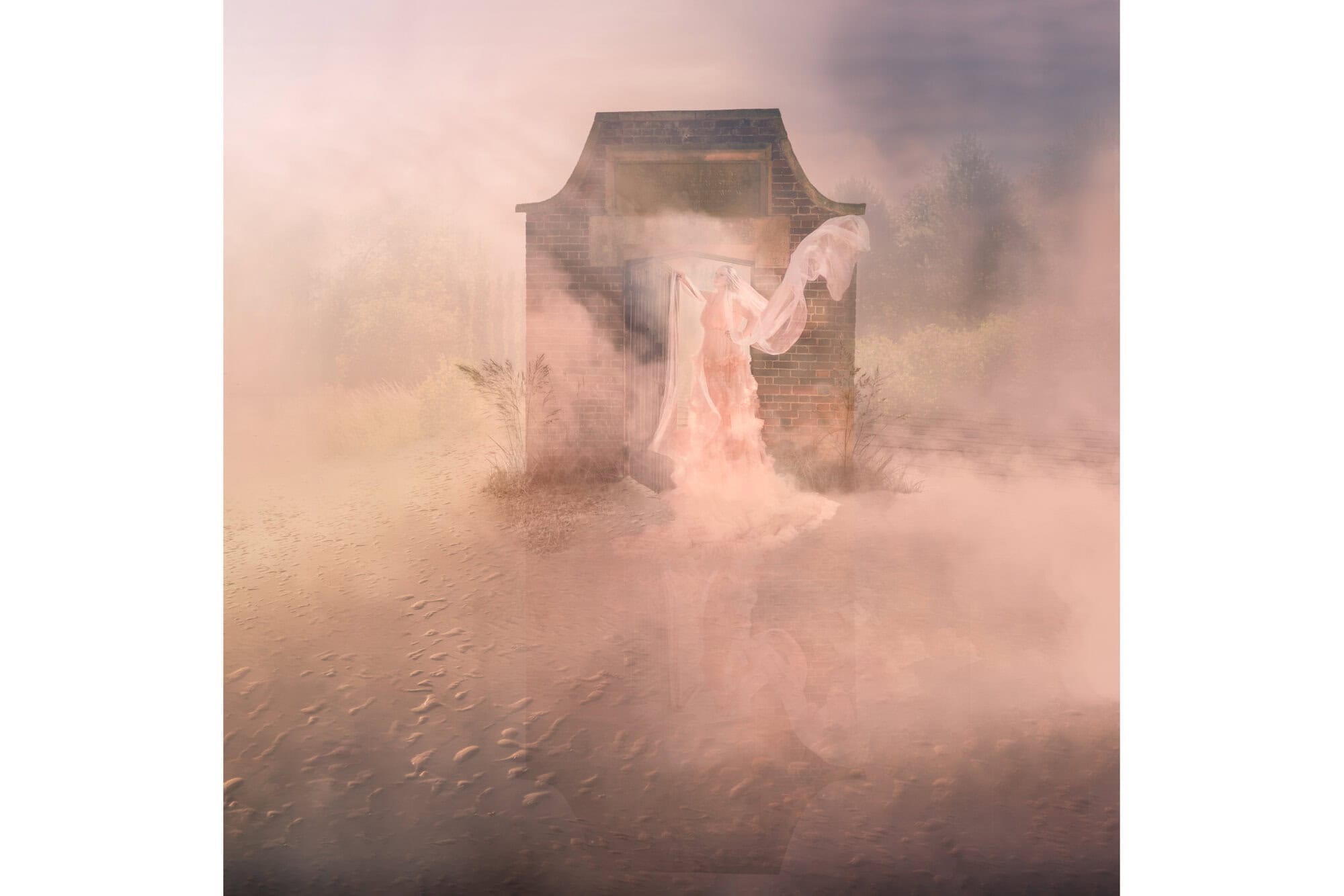
It begins with the idea
Every image starts somewhere.
Sometimes it begins with a feeling. Sometimes it comes from something I am moving through in my own life. Sometimes it starts with a colour, a place, a fragment of light, a piece of fabric, a flower, a gesture, or a question I cannot quite put down.
Before I think too much about what the photograph should look like, I ask myself what it needs to feel like.
-
What emotion starts the image?
-
What question is sitting underneath it?
-
What am I trying to say?
-
What does the image need to feel like before I know what it needs to look like?
Those questions matter because they stop the work becoming decoration. A fine art photograph needs more than a pretty location or a beautiful dress. It needs a reason to exist.
Sometimes the answer is clear. I might know I want the image to feel soft, still, and intimate. Other times it takes longer. I might only know that I want it to hold a sense of freedom, grief, renewal, longing, quiet strength, or coming back to yourself.
That is often where the image really begins.
Not with the camera.
With the feeling.
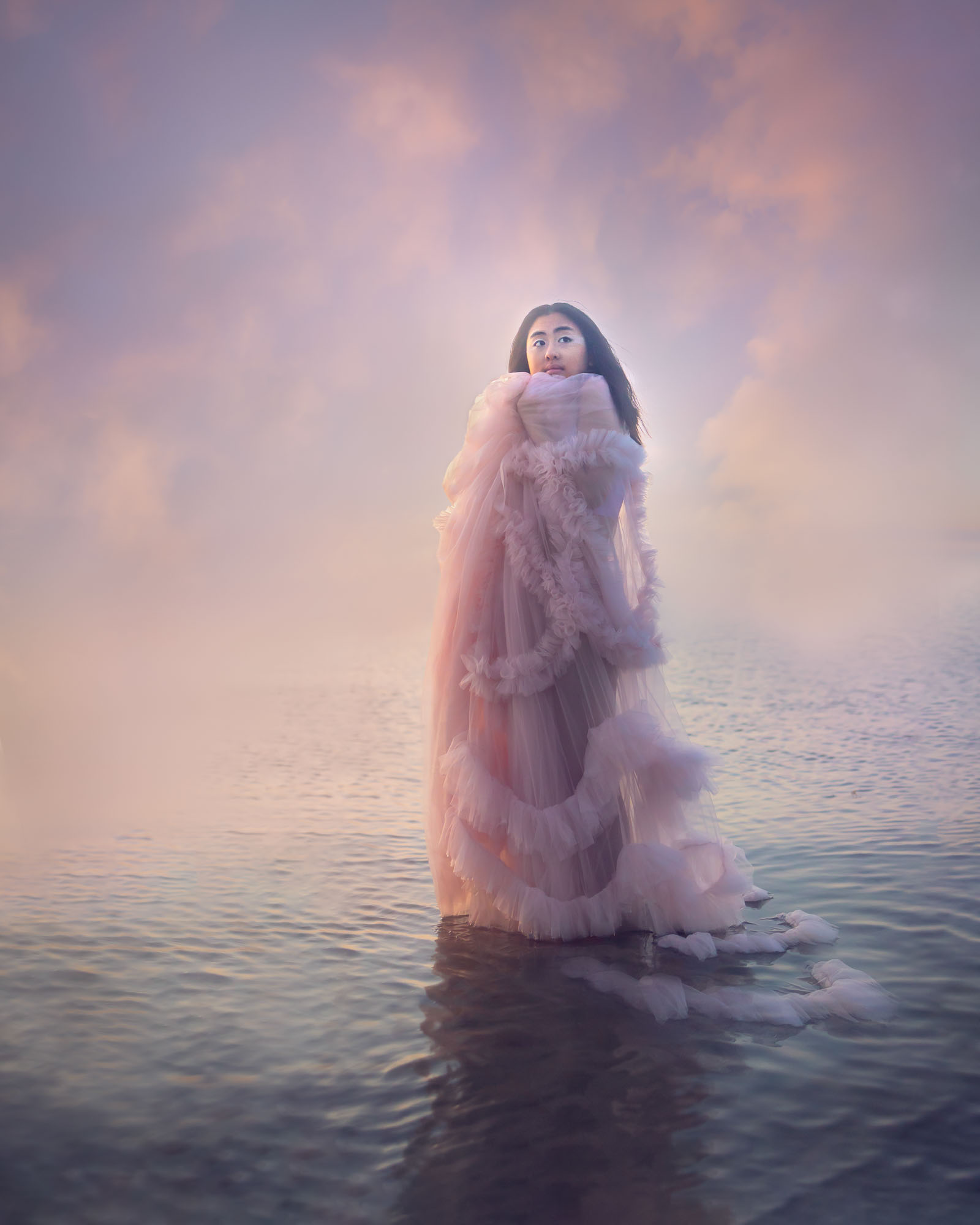
One is example of this is Release Yourself. I knew I needed to do a series of shots involving the Tamarisk tree. Several grow wildly on the coast here in Whitstable and in the spring they produce the most vibrant but soft pink fluffy flowers. They smell divine. The Tamarisk tree is also often a symbol of rebirth and hope. I shot a series of images, some with really obvious references to the tree and others more subtle, like this one. Here the young woman in the image is rediscovering her freedom and experiencing her own renewal, in the calm and tranquil waters of Tankerton bay. I asked the model to really lean into the feeling of letting go, of experiencing yourself fully and taking up space.
The tamarisk flowers in her hair had mostly fallen out and around her, spreading into the open, infinite waters. This added to the sense of rebirth and renewal, and of hope to come. I love this shot because it really speaks ‘freedom’ to me when you just pause long enough to let yourself shine through.
When I first saw the Tamarisk tree, I knew immediately I had to somehow get it into the sea at a liminal time of day, in this case the sunset. I wanted the light to feel soft and inviting. I wanted her dress to flow and express itself as much as the young woman wearing it and so I chose the light and transparent tulle fabric which billows in the wind.
From the initial feeling of ‘renewal’ and ‘hope’, I start to build the world around it. I think about the landscape, the light, the body, the clothing, the colours, and the mood. I ask what will support the feeling and what will distract from it.
This is where removal becomes just as important as adding.
Too much can weaken an image. Too many props, too many colours, too much styling, too much obvious meaning. Sometimes the strongest choice is the simplest one. One figure. One gesture. One piece of fabric moving in the wind. One stretch of sea. One patch of light.
Originally in Release Yourself, I’d put many more flowers in her hair but it looked too staged, so I let them all fall naturally it and it resulted in a more flowing look.
The idea usually tells me what it needs, but only if I stay quiet enough to hear it.
Planning the fine art photograph shoot
Once the idea has begun to take shape, I start making practical decisions.
This is the less romantic part, although it has its own kind of magic. It is also the bit where I become very aware that nature does not care about my carefully planned creative vision.
The location matters enormously. I ask myself what kind of place will hold the mood of the image. Does it need the openness of the sea? The stillness of woodland? The softness of long grass? The drama of cliffs, clouds, or water? Does the subject need space around them, or should the landscape feel close and intimate?
Light is another decision. Soft light can make an image feel tender and quiet. Stronger light can bring contrast, energy, and drama. Early morning can feel still and otherworldly. Evening light can feel warmer, more reflective, more like an ending or a release.
Then there is the model or subject. I think about how they move, what they bring emotionally, and how comfortable they feel in the environment. I am not looking for perfection. I am looking for presence. The way someone holds their hands, turns their head, closes their eyes, or lets themselves soften into the moment can completely change the image.
Clothing is part of the story too. Fabric can create movement, shape, and softness. Colour can pull the image together or make it feel too busy. Texture can add depth. Sometimes clothing needs to feel like it belongs to the landscape. Sometimes it needs to contrast with it.
I also think about timing and weather.
Tide times (I even have a little book that tells me the tide times for the year!). Wind direction. Cloud cover. Rain. Mud. Cold feet. Hair doing something deeply unhelpful. All the glamorous realities of fine art photography.
I can plan as much as I like, but the shoot always becomes a conversation with what is actually there.
The weather might shift. The light might disappear. The wind might do the exact opposite of what I hoped. A location that looked perfect in my mind might feel wrong on the day. A prop might not work. A pose might feel too forced. A quiet accident might become the best part of the whole image.
That is where I have to respond rather than control.
I ask myself:
What is happening here that I did not expect?
Can I use it?
Does this change the feeling of the image?
What needs to be stripped back?
What am I trying too hard to force?
Often, the image becomes stronger when I stop clinging to the original plan. There is a moment in most shoots where the idea begins to breathe on its own, and my job is to notice it.
Sometimes that means changing direction completely. Sometimes it means asking the model to move less. Sometimes it means letting the fabric fall naturally instead of arranging it perfectly. Sometimes it means waiting for the wind, the light, or the expression that says more than anything I could have planned.
That is the part I love.
The space between intention and chance.
An example of this was when I was shooting Life is Happening All Around Us. I rarely tell the model what poses to do and instead ask them to lean into a certain feeling or description.
I often play music that sets the scene, and feel into the moment myself. With this image, I asked the young woman to let go completely, to feel herself be carried by the Earth, the sea and the sky.
She instinctively leant back into this gorgeous arch, and the fabric on her dress billowed out in the opposite direction. The fact her hand went so near, but not overlapping, the setting sun was a gorgeous metaphor; she was reaching for the light and practically had it in her hands. None of that was a pre-determined image, it just happened in the moment.
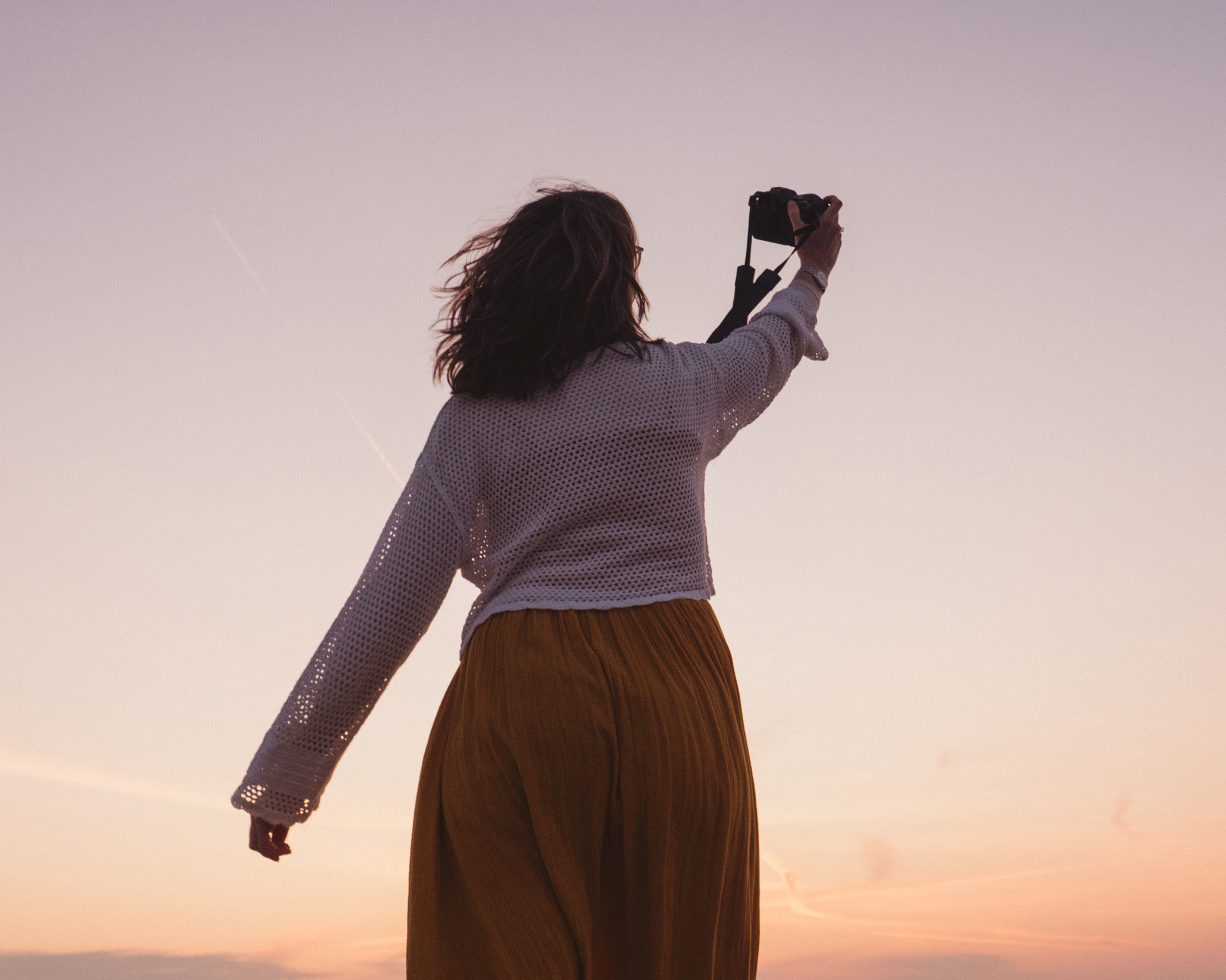
Editing the image
Editing is where the photograph becomes quieter, clearer, and more itself.
I do not see editing as fixing. I see it as listening again.
When I look at the image, I ask what is already there. What is the emotional centre of it? Where does my eye go first? What supports the feeling? What pulls me away from it?
Then I begin making decisions.
What needs to be softened?
What needs to be deepened?
What needs to be blurred, darkened, lifted, removed, or simplified?
What is too loud?
What is not saying enough?
The edit is often about restraint. It can be tempting to keep adding, especially when you have so many tools available. More contrast. More colour. More detail. More drama. But more is not always better.
Sometimes the image needs less.
Less distraction. Less sharpness. Less visual noise. Less of the real world showing itself too clearly.
I might soften the edges to pull the viewer into the subject. I might darken areas that compete for attention. I might remove tiny distractions that break the mood. I might reduce colours so the image feels more cohesive. I might add a little blur or movement if the image needs to feel more dreamlike.
But the most important question is always this:
Does the edit protect the emotional truth of the image?
Because it is possible to overwork something until it loses the thing that made it special.
I want the final image to feel considered, but not lifeless. Polished, but not sterile. I still want to feel the weather, the movement, the uncertainty, the breath of the moment.
A fine art photograph can be carefully made and still feel alive.
That is the balance I am looking for.
For those interested I mostly use Photoshop to edit my images, sometimes Lightroom. I like to mix it up as it keeps me on my toes rather than falling into a ‘tick box’ habit of editing. Of course, I want my images to look and feel like a Louisa Peacock photo and so deploy many similar techniques, however, I also still like to leave a little room for play and experimentation to allow the image to really speak and shine the way it intended.
Turning the fine art photograph into a print
The image changes when it becomes physical.
On a screen, a photograph can feel temporary. It can be scrolled past, resized, brightened, flattened, or lost among a hundred other images. As a print, it becomes something else.
It has weight.
It has texture.
It asks you to slow down.
Printing is where the photograph becomes an object, not just an image. This is why the choices at this stage matter so much.
The paper, the finish, the scale, and the texture all affect how the image feels.
A soft, textured paper can make an image feel more painterly and intimate. A larger scale can give the subject more presence. A certain finish can deepen the shadows or soften the highlights. The wrong paper can make an image feel too flat, too glossy, or too far away from what I intended.
So I ask:
-
How does this image want to be held?
-
Does it need softness or depth?
-
Does it need space around it?
-
Should it feel quiet and intimate, or larger and more immersive?
-
What changes when I see it away from the screen?
Printing also reveals things. Sometimes an image that felt finished digitally needs a little more work once I see it in print. A shadow might need lifting. A tone might feel too heavy. A detail I loved on screen might not matter at all in the physical piece.
There is a different kind of honesty in print.
You cannot hide behind the glow of a screen. The image has to stand on its own.
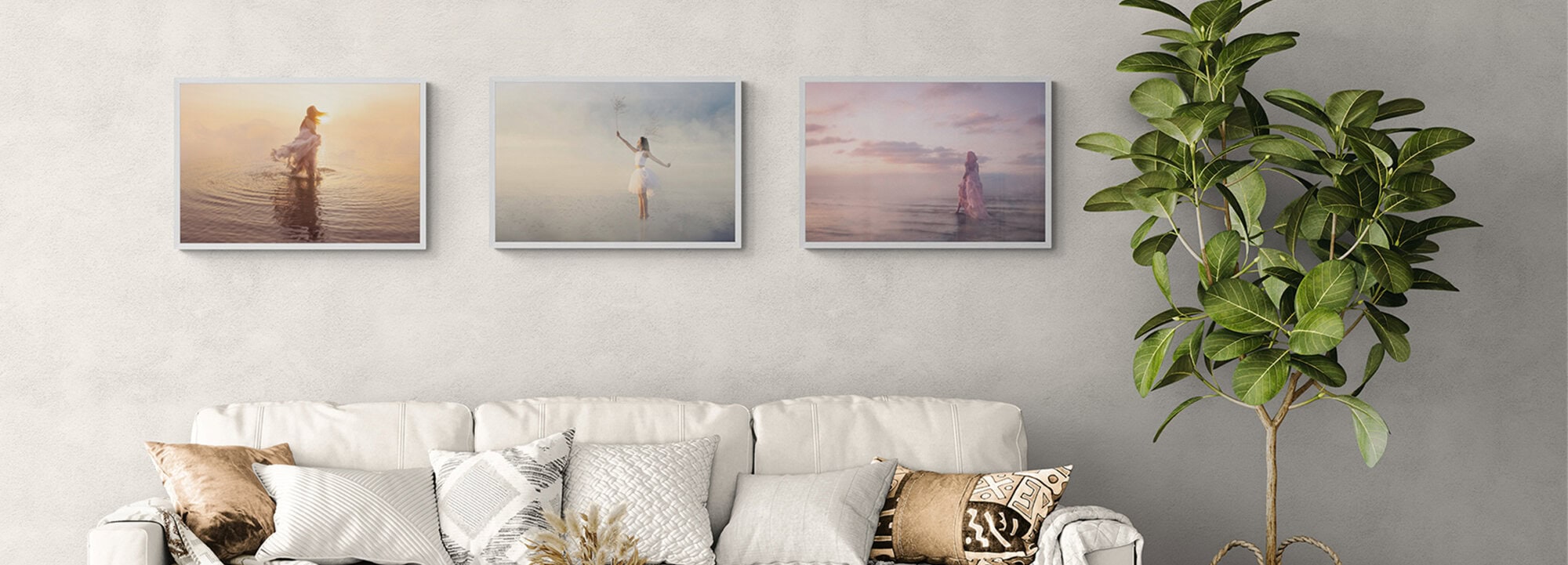
For my prints I work with Hahnmeule Fine Art Pearl paper and a professional photography lab, who often frame each image with a simple white tray frame, elevating them into a beautiful piece of wall art. Some images, like The Awakening, are printed in Gloss Acrylic because they just need that pop of colour you get when using such a vibrant material.
And then comes the final question.
How do I know when it is complete?
Usually, it is less dramatic than people might imagine. There is not always a grand moment. Often, it is a quiet knowing.
The image stops asking for more.
The feeling is there.
The unnecessary pieces have gone.
The print holds the mood I wanted it to hold.
That is when I know.
What I leave to chance
Although my work is intentional, I never want to remove chance completely.
Chance is where some of the most honest parts of the image appear.
The wind lifting fabric in a way I could never have arranged. A subject’s expression between poses. A shift in light. A sudden mist. The sea moving differently. A bird crossing the frame. A moment of laughter when everything has become too serious and we all need to stop pretending we are not freezing.
I plan carefully, but I also leave room for the unexpected.
That balance matters.
Too much control can make an image feel stiff. Too little intention can make it feel confused. Somewhere between the two is the place I am always trying to reach.
An image that has been shaped with care, but still has breath in it.
That, for me, is what creating a fine art photograph is really about.
It is not just the idea, the shoot, the edit, or the print.
It is the decisions between those stages.
It is what I choose to keep, what I choose to remove, and what I allow to happen.
It is a process of listening, responding, simplifying, and trusting.
And when it works, the finished photograph feels like it has always existed somewhere, waiting to be found.
Louisa Peacock creates timeless, elegant photography with a fine art photograph feel, capturing people, stories and meaningful moments with care and intention. Her work blends beautiful natural light, thoughtful composition and a calm, personal approach, helping clients feel relaxed while creating images that feel refined, emotive and lasting.

